
Ear conditions
Constricted ear in newborns
In a constricted ear, the outer rim of the upper ear is tight, as if drawn in by a purse string. The top of the ear may fold over, look cupped or appear smaller than the other ear. Cup ear and lop ear are names for forms of constricted ear.
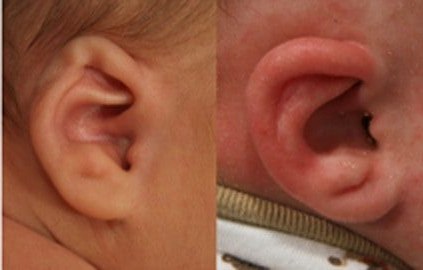
What a constricted ear looks like
Constricted ears range from mild to more marked:
- Mild: the upper rim is slightly tight or folded and the ear is a little smaller at the top.
- Lop ear: the top of the ear folds down more noticeably.
- Cup ear: the upper ear is tight and cupped, and the ear may also stand out.
In more marked forms, some tissue at the top of the ear may be short, which affects what molding can achieve.
How it is assessed
The clinician measures how tight the rim is, how much the top folds, and whether the tissue is all present. They compare both ears and check related features, such as a helical rim difference or prominence.
Is molding considered for constricted ears?
It may be, particularly for milder forms while the cartilage is soft. Constricted ears can take longer to respond than some other shapes, and the result depends on how much tissue is available. The clinician will be clear about realistic expectations. Treatment timeline.
Cup, lop, prominent and lidding
These words are used differently across websites. On our site, cup and lop ears are forms of constricted ear. A prominent ear stands out but has a normal rim, and lidding is a fold of the upper rim without the same tightness. Some ears have more than one feature, described as a mixed shape.
Questions about constricted ears
What is a constricted ear?
It is an ear whose upper rim is tight, so the top folds, cups or looks smaller. Cup ear and lop ear are forms of constricted ear.
How is a constricted ear assessed?
A clinician examines how tight and folded the rim is and whether all the tissue is present, and compares both ears.
Can molding help a constricted ear?
Molding may be considered, especially for milder forms while the cartilage is soft. More marked forms may respond less because tissue can be short. Candidacy.
What is the difference between a cup ear and a prominent ear?
A cup ear has a tight, cupped upper rim and is a form of constricted ear. A prominent ear stands out from the head but usually has a normal rim. Prominent ears.
Does a constricted ear take longer to treat?
It can, because the rim needs to be gently expanded. The clinician will estimate the timeline for your baby.
Questions about your baby’s ears?
Request an evaluation with EarWell Centers or call our team. We will help you understand the next step.