
Treatment overview
Infant ear molding
Infant ear molding is a nonsurgical treatment that gently guides the shape of a newborn’s ear while the cartilage is still soft. At EarWell Centers, our clinical team fits and monitors the EarWell Infant Ear Correction System, invented by Dr. Steve Byrd, MD.
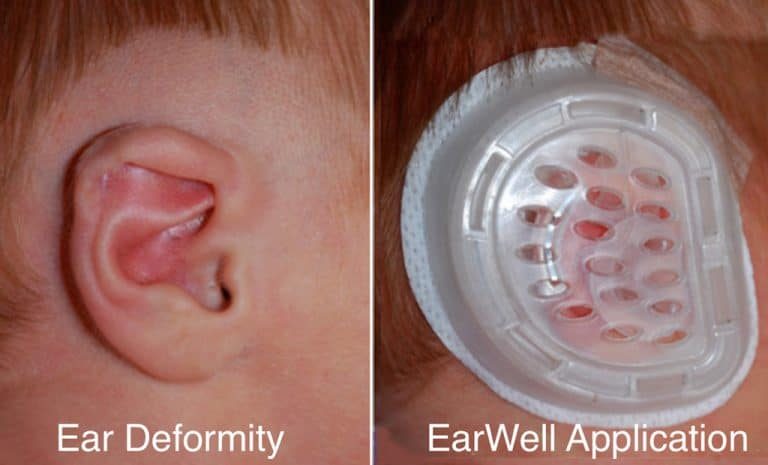
How ear molding works
At birth, a baby’s ear cartilage is usually soft and flexible. Over the following weeks it gradually becomes firmer. Ear molding uses this window: a custom-fitted device holds the ear in a more typical shape so the cartilage can firm up in that position.
Molding works on the shape of ear tissue that is already there. It does not add tissue that is missing, which is why ears with microtia need a different approach.
What treatment involves
- Evaluation. A clinician examines both ears, reviews your baby’s age and health, and explains whether molding may help. Who may be a candidate.
- Fitting in the office. If you choose treatment, the team prepares the skin around the ear, which may include trimming a small area of hair, and fits the device. No surgery, needles or anesthesia are involved.
- Wearing the device. Your baby wears the device continuously between visits. You will receive instructions for bathing, sleeping and feeding. Aftercare at home.
- Follow-up and adjustment. You return for scheduled checks. The team looks at the skin and the ear, and adjusts or replaces the device as the shape changes. Treatment timeline.
- Completion. When the clinician decides the shape is stable, the device is removed and you discuss the result and any follow-up.

How treatment is monitored
Molding is supervised medical care, not a one-time fitting. At each visit the team checks the skin under and around the device, how well it fits, and how the ear shape is responding. If the skin needs a rest or the shape is changing differently than expected, the plan is adjusted. Between visits you can call 214-540-1428 with concerns. Possible side effects.
How molding differs from ear surgery
Ear surgery (otoplasty) reshapes the ear through incisions and is usually considered in later childhood or adulthood. Molding is nonsurgical and is used in early infancy while the cartilage is soft. They are not interchangeable: some ear shapes respond well to molding, while others may need a surgical opinion later. Compare ear molding and otoplasty.
Conditions we evaluate
Molding may be considered for many newborn ear shape differences, including Stahl’s ear, lidding, prominent ears, constricted ears, helical rim differences, cryptotia, conchal crus and mixed shapes. See all ear conditions.
Sources
- Ear molding in newborn infants with auricular deformities. Byrd HS, Langevin CJ, Ghidoni LA. Plastic and Reconstructive Surgery 126:1191. 2010.
- Classification of newborn ear malformations and their treatment with the EarWell Infant Ear Correction System. Daniali LN, Rezzadeh K, Shell C, Trovato M, Ha R, Byrd HS. Plastic and Reconstructive Surgery (copy hosted by EarWell Centers).
Explore treatment in more detail
The EarWell Infant Ear Correction System
What the device is, who applies it and how it is monitored.
When to start ear molding
Why timing matters, and how we assess babies of different ages.
Is your baby a candidate for ear molding?
Which ear shapes we assess, and when other care may be a better fit.
Ear molding treatment timeline
How long treatment usually lasts, and what happens at each stage.
Aftercare at home during ear molding
Bathing, sleeping and skin checks while your baby wears the device.
Ear molding risks and side effects
Skin effects, comfort, and how treatment is monitored and adjusted.
Questions about ear molding
How does ear molding change the shape of the ear?
It holds the ear in a more typical shape while newborn cartilage is soft, so the cartilage firms up in that position over the course of treatment. It does not cut or remove tissue.
Does ear molding hurt my baby?
The device is applied without needles or anesthesia, and many babies sleep and feed normally while wearing it. Some babies have skin irritation where the device rests, which is why the team checks the skin at every visit. Read about side effects.
How is treatment monitored?
You return for scheduled follow-up visits so the team can check the skin, the fit of the device and how the ear is responding, and make adjustments. You can call between visits if you are worried.
How is ear molding different from ear surgery?
Molding is nonsurgical and is used in early infancy while the cartilage is soft. Otoplasty is surgery that is usually considered later in childhood or adulthood. Compare the two approaches.
Can both ears be treated at the same time?
Yes. If both ears have a shape difference, the clinician may recommend treating both. The plan depends on each ear’s shape.
Questions about your baby’s ears?
Request an evaluation with EarWell Centers or call our team. We will help you understand the next step.