
For providers
Identifying newborn ear deformities
A brief look at both auricles during the newborn exam can identify most shape differences. This guide summarizes common patterns, terminology and when to refer.
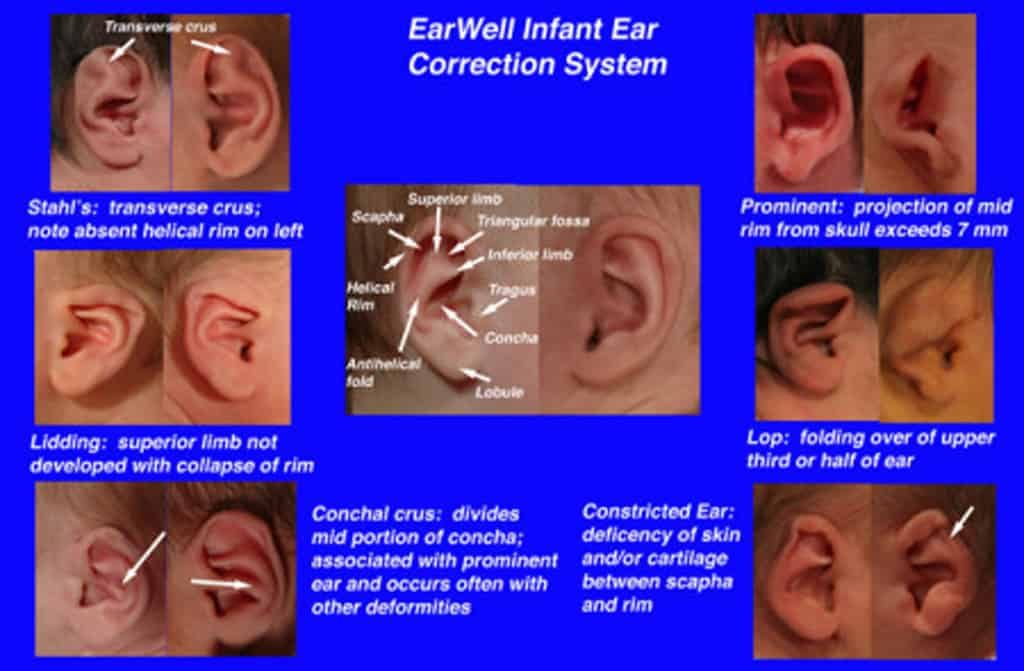
Common patterns
- Lidding: superior helix folds over the scapha. Details
- Stahl’s ear: an extra (third) crus extending toward the helix, with a pointed superior pole. Details
- Prominent ear: increased auriculocephalic angle, often from an effaced antihelical fold or deep concha. Details
- Constricted ear: tight helical rim with folding of the superior pole; includes lop and cup forms. Details
- Helical rim difference: flattened, compressed or irregular helix. Details
- Cryptotia: superior pole buried beneath temporal skin, absent retroauricular sulcus. Details
- Conchal crus: an abnormal cartilage ridge crossing the concha. Details
- Mixed: combinations of the above. Details
Deformity versus malformation
Deformities have normal tissue in an abnormal shape and may be suitable for molding. Malformations involve missing tissue, as in microtia or anotia, and need hearing assessment and specialist referral rather than molding. Microtia and anotia.
Overlapping terms
“Cup ear” and “lop ear” are used inconsistently. We group them with constricted ears and distinguish them from prominent ears, which have normal rim tissue. When referring, a short description of what you see is more useful than a label.
Referral timing
Refer as soon as a difference is noticed. Neonatal cartilage is generally most pliable in the first weeks of life. Older infants can still be referred and are assessed individually.
Questions about recognition
Which features should prompt a referral?
A folded superior pole, a pointed upper ear or extra crus, a tight or flattened helix, increased prominence, a buried upper pole or a ridge across the concha.
How do the terms cup ear, lop ear and prominent ear differ?
We use cup and lop ear for forms of constricted ear with a tight rim. Prominent ears stand out from the head but have normal rim tissue.
When is the best time to refer?
As soon as the difference is noticed, ideally in the first weeks. Older infants can still be evaluated.
What can molding not treat?
Missing tissue (microtia, anotia), ear tags and pits, hearing loss and head shape. These need other specialist pathways.
Refer a newborn
Call 214-540-1428 to arrange an evaluation.